


SOUTHERN LEBANON — The first sign that something has changed comes before the destruction.
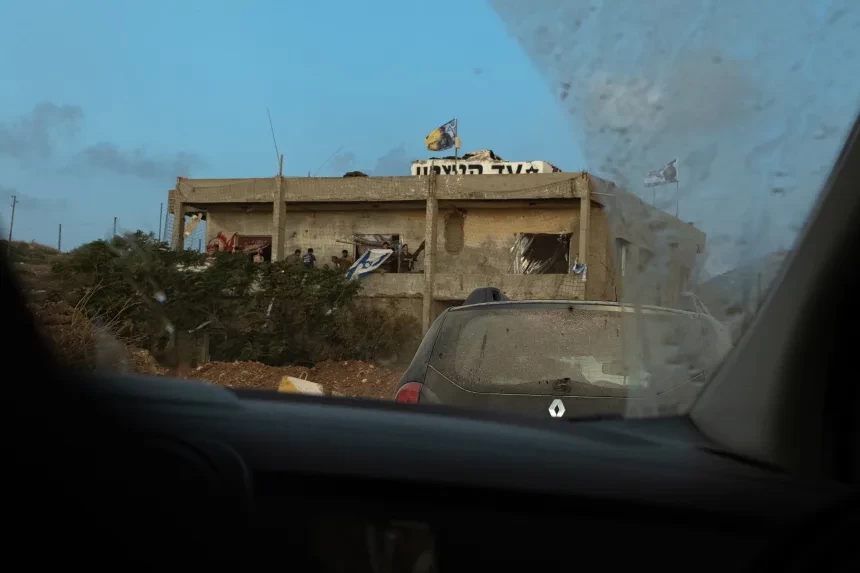
Driving south along Lebanon’s coastal roads, the familiar Lebanese and Hezbollah flags gradually disappear. In their place are Israeli flags. Then come military checkpoints, soldiers watching from damaged buildings and roads leading into territory few civilians can freely enter.
Beyond the checkpoints, the landscape changes dramatically.
Entire neighborhoods have been reduced to rubble. Houses stand shattered or have disappeared completely. In some villages, residents say they can hear controlled demolitions almost every day.
This is southern Lebanon more than a year into another cycle of conflict — a region where a ceasefire exists on paper, but where many people say peace remains painfully distant.
A ceasefire that doesn't feel like one
Israel says its military presence in southern Lebanon is necessary to protect communities in northern Israel from Hezbollah, the Iran-backed Lebanese militant group.
Israeli forces have established what they describe as a security zone extending roughly 6 miles into Lebanese territory.
The consequences have been devastating for many communities.
Lebanon’s Health Ministry says thousands of people have been killed since the latest fighting began, while the United Nations estimates that hundreds of thousands have been displaced.
Yet amid the destruction, several predominantly Christian villages have survived relatively intact.
Rmeish, Ain Ebel and Debel are still home to families who refused — or were unable — to abandon their communities.
Their survival, however, has come at a price.
Residents cannot simply drive to Beirut or other parts of Lebanon. Travel in and out often requires joining a convoy coordinated through an international monitoring system and obtaining approval from Israeli authorities.
For families already struggling financially, that isolation has become another burden of war.
Going home doesn't mean coming back to normal
For Ronnie and Rita Alam, returning to Rmeish was supposed to be a homecoming.
Instead, it became a reminder of what the conflict had taken from their family.
The couple had fled with their two daughters as Israeli bombardment intensified. They spent months living in Beirut, where rent put additional pressure on their finances.
When Rita returned to Rmeish with the children, Ronnie had to remain in Beirut for work.
The family was home again — but no longer together.
“Our family is being separated,” Rita said.
For many residents, that is the reality behind the statistics.
Displacement is not simply about losing a house. It can mean losing a job, separating families, abandoning farms and cutting people off from schools, hospitals and relatives.
Between Israel and Hezbollah
Southern Lebanon has long been one of the most complicated fault lines in the Middle East.
Hezbollah has deep roots in many Shia-majority communities across the region. The group operates both as a political organization and an armed force, and its confrontation with Israel has repeatedly turned southern Lebanon into a battlefield.
But not everyone living there supports Hezbollah.
Yorgos Mitri, a resident of Ain Ebel, openly blames the group for helping trigger the latest conflict.
Still, he also sympathizes with the civilians living in neighboring Shia communities that have suffered extensive destruction.
“Nobody deserves this,” he said.
That sentiment captures a central tension in southern Lebanon: civilians can reject Hezbollah while simultaneously opposing the destruction caused by Israel’s military campaign.
For them, choosing between the two is not the same as choosing peace.
A fragile experiment
Under a framework agreed between Israel and Lebanon, some areas occupied by Israeli forces are supposed to be transferred to the Lebanese army.
The first of these so-called “pilot zones” are intended to demonstrate that Lebanese forces can restore state authority while preventing armed groups from operating there.
But the experiment faces enormous obstacles.
Lebanon’s military is underfunded. Its soldiers operate with limited resources, while unexploded ordnance and continued Israeli attacks pose additional dangers.
In Zawtar al-Gharbiyeh, one of the pilot zones visited by CNN, fewer than one in 20 displaced residents had returned, according to the Lebanese army.
That number matters.
A peace agreement can redraw military boundaries on a map. It cannot automatically convince families that it is safe to sleep in their homes again.
The sound of war has become ordinary
During a patrol with Lebanese soldiers, artillery fire erupted nearby.
Four strikes landed within roughly 20 minutes.
The soldiers barely reacted.
For people living here, such moments have become part of everyday life.
Col. Raja Amer, a Lebanese army officer involved in operations in the south, said his forces had recorded thousands of Israeli attacks since the framework agreement was signed.
From the Lebanese military’s perspective, the challenge is to expand state control without reigniting the sectarian tensions that have repeatedly torn the country apart.
Moving too aggressively against Hezbollah could provoke backlash. Moving too slowly could leave Israel convinced that Lebanon is failing to enforce its commitments.
The army is caught in the middle.
The question neither side has answered
Israel says it wants security.
Lebanon says it wants its territory back.
Hezbollah says it retains the right to resist what it considers Israeli aggression.
And civilians want something much simpler: to go home without wondering whether another airstrike is coming.
That gap between political objectives and civilian reality may be the biggest obstacle to a lasting settlement.
In southern Lebanon, the physical evidence is impossible to miss. Israeli checkpoints stand beside destroyed homes. Military vehicles move through territory where families once farmed. Entire communities remain displaced.
And in the villages where people have returned, the sound of aircraft and artillery has become familiar enough that children can recognize it.
Mahmoud Darwish returned to Zawtar al-Gharbiyeh after months away. His home was badly damaged. The olive trees that once provided his livelihood were destroyed.
Standing among the rubble, he made clear that leaving was not an option he was willing to accept forever.
The message from people like Darwish is not complicated.
They may have lost their homes, their livelihoods and their sense of security.
But they have not surrendered their claim to the land.
And that leaves southern Lebanon facing a difficult question: Can a ceasefire hold when the people living beneath it still hear the sound of war?




Reader discussion
Comments 0
No comments yet. Be the first to join the conversation.